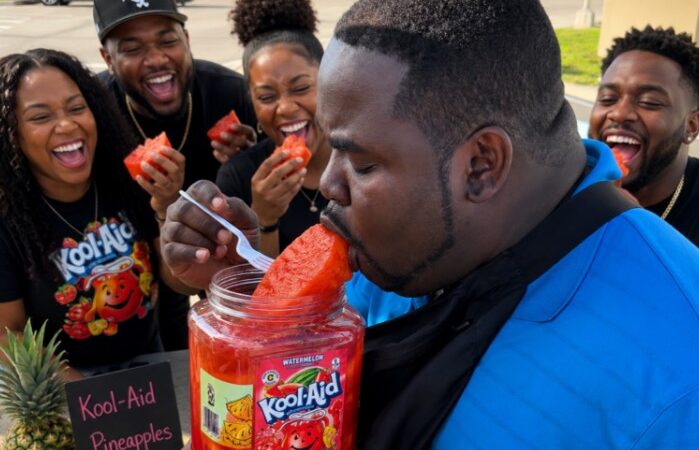
A brightly colored pineapple-and-Kool-Aid snack moved from neighborhood sellers to national feeds in late spring 2026, helped by a rush of Instagram, TikTok and X videos. I took a close look at the viral Kool-Aid pineapple jars now being sold out of cars and pop-up spots, and seven things stood out immediately.
1. The trend became a real thing fast, not gradually
Kool-Aid pineapple is exactly what it sounds like: pineapple chunks or spears soaked or coated with flavored Kool-Aid mix, often with extra sugar added to the jar. Know Your Meme says the format was popularized online in late May and early June 2026, while Click2Houston reported on June 10 that videos had already spread across TikTok, Instagram and Facebook in the span of days.
One of the clearest markers in that timeline is a May 29, 2026 X post tied to the phrase “one jar can change your life,” which Click2Houston and Know Your Meme both identified as a key moment in the trend’s wider spread. That date matters because it shows how quickly the snack jumped from a niche street-style item into a broader social media product.
What I noticed first is that this did not feel like a slow-burn recipe trend. It looked more like an instantly recognizable packaged product, with jars, colors and catchphrases that were easy to film and easy to resell. Foodbeast reported that the jars were already showing up across neighborhoods in the South and Midwest by early June.
2. Selling out of a car is not a side detail; it is part of the product
The phrase in your headline is not just colorful wording. The car-side sale has become part of the item’s identity because many of the early viral sellers were moving jars directly from trunks, back seats or coolers rather than from traditional storefronts. Know Your Meme traced one of the earliest prominent sellers to Broward County, Florida, where Willie Reynolds, known online as Silly Willie, posted videos throughout 2026 under the name Pineapple Dreamz.
According to that timeline, Silly Willie posted a Kool-Aid pineapple video on April 23, 2026, after first mentioning the product on April 20. That makes the informal sales setup part of the trend’s documented origin story, not just a copycat phase that came later.
What stood out to me is that the car sale changes how the snack is perceived. It feels less like a grocery item and more like a neighborhood pickup, similar to plate lunches, boiled peanuts or lemonade-stand products that spread through word of mouth before national media notices them. Foodbeast said the jars are often being sold by young entrepreneurs and local snack vendors, which fits that pattern.
3. There is no single confirmed inventor, but there are clear early faces of the craze
This is one of the first things worth stating plainly: there is no fully verified, public record showing who invented Kool-Aid pineapple. Click2Houston said the exact origin is unclear, and Foodbeast said the same while noting that one viral clip helped push the product to a much larger audience.
Still, several names keep appearing in credible coverage of the trend’s early spread. Know Your Meme pointed to Silly Willie in Broward County as an early major figure. Foodbeast highlighted Wilmington, North Carolina-based Drip Jars and its owner, Lilktye, as another visible seller who helped move the snack from local sales into viral view counts.
That distinction matters because “viral” can blur the line between inventor and amplifier. What I noticed is that the product behaves like a social media franchise even without formal branding: one seller proves the visual formula works, another seller lands an 11 million-view clip, and then versions start appearing in multiple cities with similar jars, colors and slang attached. Foodbeast specifically reported that Lilktye’s video drew more than 11 million views.
4. The colors are the hook, but the sugar is the real story
The jars are built to stop a scroll. Blue Raspberry, Cherry, Grape and Pink Lemonade create bright, artificial colors that turn ordinary pineapple into something that reads more like candy than cut fruit. Click2Houston reported that users commonly describe the result as candy-like, and Foodbeast listed similar flavors in current sales.
But what I noticed after looking at how sellers and recipe pages describe the product is that fruit is only part of the equation. Kraft Heinz’s product page confirms Kool-Aid sells a wide lineup of unsweetened drink-mix packets, and social posts and recipe write-ups commonly show people adding granulated sugar separately.
That matters nutritionally. The American Heart Association recommends limiting added sugars to no more than 6% of daily calories and says many adults already exceed that amount; it also says children and adolescents should keep added sugar to 25 grams or less per day. The pineapple itself contains natural sugar, but the attention around this trend is really about how much extra sweetener can be layered onto a fruit people usually associate with being healthier.
5. It is part food trend, part microbusiness model
What makes this trend different from a typical viral recipe is that a lot of people are not just making it at home. They are packaging it, naming it and building mini brands around it. Foodbeast reported examples ranging from Drip Jars in North Carolina to Exotic Fruits in Baton Rouge, KO Spicy Bowls in Tallahassee, and restaurant tie-ins at Fatima’s Grill locations in Ohio and Michigan.
That spread suggests the appeal is not limited to one city or one platform. A jar is easy to standardize, easy to photograph and easy to sell at a set price, especially in warm-weather months when cold fruit already has built-in demand. The product also uses ingredients that are easy to source at regular grocery or warehouse stores, which lowers the barrier for sellers. Click2Houston described the recipe as simple and based on common grocery items.
What I noticed is that the business model may be as viral as the taste. In practical terms, this is a snack that can be made in batches, carried in coolers and sold directly to nearby customers without a full restaurant footprint. That is a meaningful part of why it spread so quickly online and offline.
6. The trend carries regional history, even if the pineapple version feels new
Kool-Aid pineapple may look like a new 2026 invention, but the underlying idea is older. Know Your Meme says the snack is widely understood as an offshoot of the Kool-Aid pickle, sometimes called a “Koolickle,” a Southern food tradition associated with the Mississippi Delta region.
That context explains why the product did not appear out of nowhere. The technique of using flavored drink powder to transform another food already existed, and the pineapple version simply swaps in a fruit with stronger color contrast and a sweeter baseline flavor. From a social-media standpoint, that makes sense because pineapple reads better on camera than a pickle and is easier to market as a summer snack. That last point is an inference based on how the videos and coverage describe the product’s presentation.
What I noticed here is that the trend sits at the intersection of regional snack culture and internet packaging. It feels familiar to people who know Kool-Aid pickles, but it also feels newly optimized for 2026 platforms, where visual appeal and short-form reactions can turn a local product into a national one within days.
7. For buyers, the main expectation is simple: a photogenic, very sweet jar of fruit
For customers, the practical takeaway is straightforward. You should expect a cold jar of pineapple that has been heavily flavored, brightly colored and often sweetened beyond the fruit’s natural sugar level. Depending on the seller, the texture may stay fresh and juicy or become more candy-like after soaking. Click2Houston reported that some people let the mixture sit for hours while others serve it immediately.
You should also expect variation. There is no single national recipe, no uniform ingredient standard and no public master list of vendors because this is largely an informal, local-seller market that expanded through social media rather than through a chain rollout. Foodbeast’s examples from several states underscore that different sellers are using different flavors and branding.
The last thing I noticed is that the hype is not really about complexity. It is about visibility, portability and repeatability. As of mid-June 2026, the trend remained driven by viral posts, neighborhood vendors and small operators rather than a single company, which means the product’s next phase will likely depend on whether those sellers keep converting views into repeat local sales.
8. What this says about summer food trends in 2026
The bigger story is not only that Kool-Aid pineapple got popular. It is that a low-cost, highly visual food item moved from local sellers to multi-platform virality almost instantly, with no major brand campaign behind it. Foodbeast, Click2Houston and Know Your Meme all show the same pattern: short videos, quick taste-test reactions, distinctive colors and easy replication.
That combination is increasingly common in food trends, especially in summer when cold, colorful products perform well on camera. Unlike more equipment-heavy recipe crazes, this one depends on ingredients people already recognize and a format people can buy from a neighbor, an Instagram seller or a vendor parked nearby. Click2Houston noted that the simplicity of the recipe is a major part of the appeal.
So the clearest conclusion from trying to understand this viral snack is also the simplest one: Kool-Aid pineapple is not just a weird internet food. It is a useful snapshot of how food, local hustle and short-form video now work together in 2026, with neighborhood sellers often setting the pace before national outlets catch up.