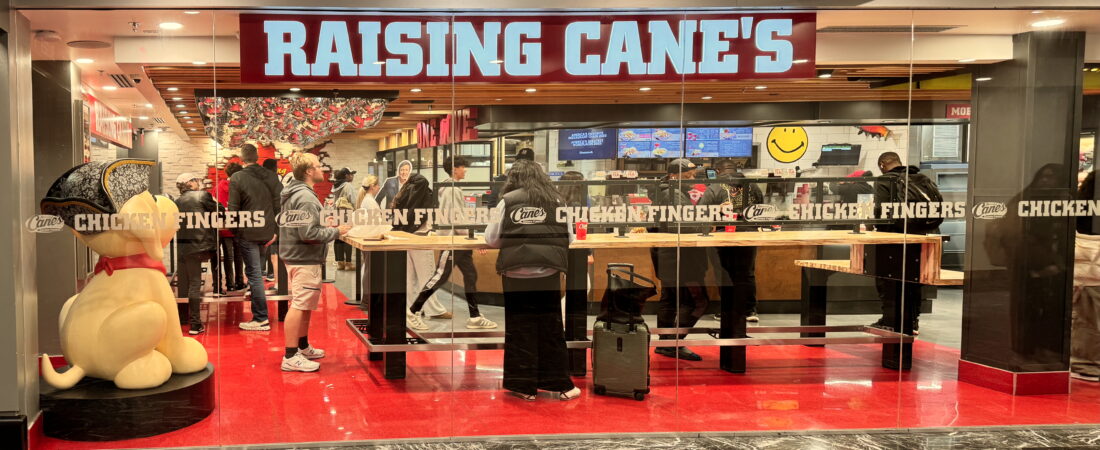
Chicken has become the fastest-growing restaurant segment in the country, according to Datassential’s 2026 industry report. The brand drawing some of the clearest expansion momentum is Raising Cane’s, a chicken-finger chain that still trails Chick-fil-A in size and sales but is growing fast enough to reset expectations about who is winning the next phase of the chicken boom.
Raising Cane’s is posting the kind of store growth that gets industry attention
The clearest reason Raising Cane’s keeps surfacing in restaurant industry coverage is simple: it is opening restaurants at a speed that stands out even inside a red-hot chicken category. QSR Magazine’s 2025 chicken-chain rankings reported that Raising Cane’s increased its U.S. unit count from 828 to 929, a net gain of 101 restaurants, while systemwide sales reached about $6.56 billion. That put the company behind Chick-fil-A and Popeyes in total chicken-chain sales, but well ahead of many rivals in sheer opening velocity.
That growth is landing at the same moment the broader category is accelerating. Datassential said in its 2026 Datassential 500 that limited-service chicken was the fastest-growing restaurant segment by unit count, posting 4.4% growth. NACS, citing the same Datassential research, reported that chicken sales climbed to $55.24 billion in 2025 and that brands including Chick-fil-A and Raising Cane’s helped push the category higher.
What makes Raising Cane’s notable is that the chain’s growth story is not built around an especially broad menu. The company has long centered its business on chicken fingers, fries, toast, slaw and sauce, a stripped-down format that restaurant analysts frequently point to as an operational advantage. QSR Magazine’s 2025 ranking also showed Raising Cane’s average unit volumes among the strongest in quick-service chicken, another sign that new stores are being added to a concept that is already producing high volumes at existing restaurants.
The company’s own expansion messaging has stayed aggressive. Multiple 2025 reports, including coverage by Fortune and Axios, said Raising Cane’s was on pace to open roughly 100 more restaurants during 2025 after setting a company record with more than 100 openings in 2024. That kind of cadence is why the chain is increasingly being described as one of the fastest-growing names in American foodservice, even if many casual diners would still guess Chick-fil-A first.
The growth is national, but the footprint is still uneven from state to state
One reason Raising Cane’s growth can feel surprising to regular customers is that the chain is still missing from parts of the country or remains lightly distributed in some major metro areas. Axios reported in January 2025 that Raising Cane’s was operating in more than 30 states at the time and was planning more than 100 openings that year, with Chicago alone lined up for multiple new restaurants. That means the brand’s national expansion story is real, but it is not yet as uniformly visible as legacy giants that have been blanketing U.S. roadsides for decades.
In practical terms, some states are now seeing the chain move from occasional novelty to everyday competitor. Chicago offers one example. Axios said the January 28, 2025 opening in Lincoln Park was only the start of a larger local push that also included planned locations in River North, Chatham and Chicago Ridge. That kind of clustered development matters more than a single ribbon-cutting because it changes how often diners encounter a brand during normal routines.
Other markets are still earlier in the rollout. Previous openings in places like North Carolina showed how the brand often enters a region near universities or high-traffic corridors first, then builds outward. The company has not released a single, comprehensive public list covering every affected city or state in one place, so the full market-by-market picture can be harder for consumers to track than the headline number of total openings.
That uneven footprint helps explain the disconnect between awareness and growth. Chick-fil-A remains larger and more entrenched nationally, and Wingstop has its own strong consumer recognition, but Raising Cane’s is the chain that keeps turning up in expansion stories because it is still filling in large parts of the map. For customers, the surprise is less about whether the company is growing and more about how many markets are only now getting a meaningful cluster of locations.
A narrow menu, high volumes and a hot category are driving the push
The biggest structural reason behind Raising Cane’s rise is that it is expanding during a period when chicken is outperforming other restaurant segments. Datassential’s 2026 data showed limited-service chicken leading all restaurant segments in unit growth, while broader industry growth remained much more modest. That gives brands in the category a favorable backdrop, especially those with simple operations and a clear identity.
Raising Cane’s also appears to benefit from a business model that is easier to replicate than more complex fast-food concepts. Industry rankings from QSR Magazine showed unusually high average unit volumes for the chain, which suggests franchise-quality economics even though Raising Cane’s itself is largely company-operated. Restaurant analysts have long tied strong unit economics to faster development because high-volume stores make it easier to justify new construction, real estate competition and labor investment.
There is also a contrast effect at work. Chick-fil-A remains the category’s sales giant and added 178 net new units in 2025, according to NACS’ summary of Datassential data, but its scale makes hyper-fast percentage expansion harder. Raising Cane’s, by comparison, is still at a stage where adding around 100 stores in a year materially changes its national footprint. In other words, it does not have to surpass Chick-fil-A in total size to become one of the most important chicken growth stories in the country.
For customers, that means more new Cane’s locations are likely to keep appearing in markets where the brand once had little or no presence, though exact city-by-city timing still depends on the company’s development pipeline and local approvals. What is already confirmed is that chicken remains a growth engine for U.S. restaurants, and Raising Cane’s has positioned itself as one of the chains moving fastest to capture that demand.